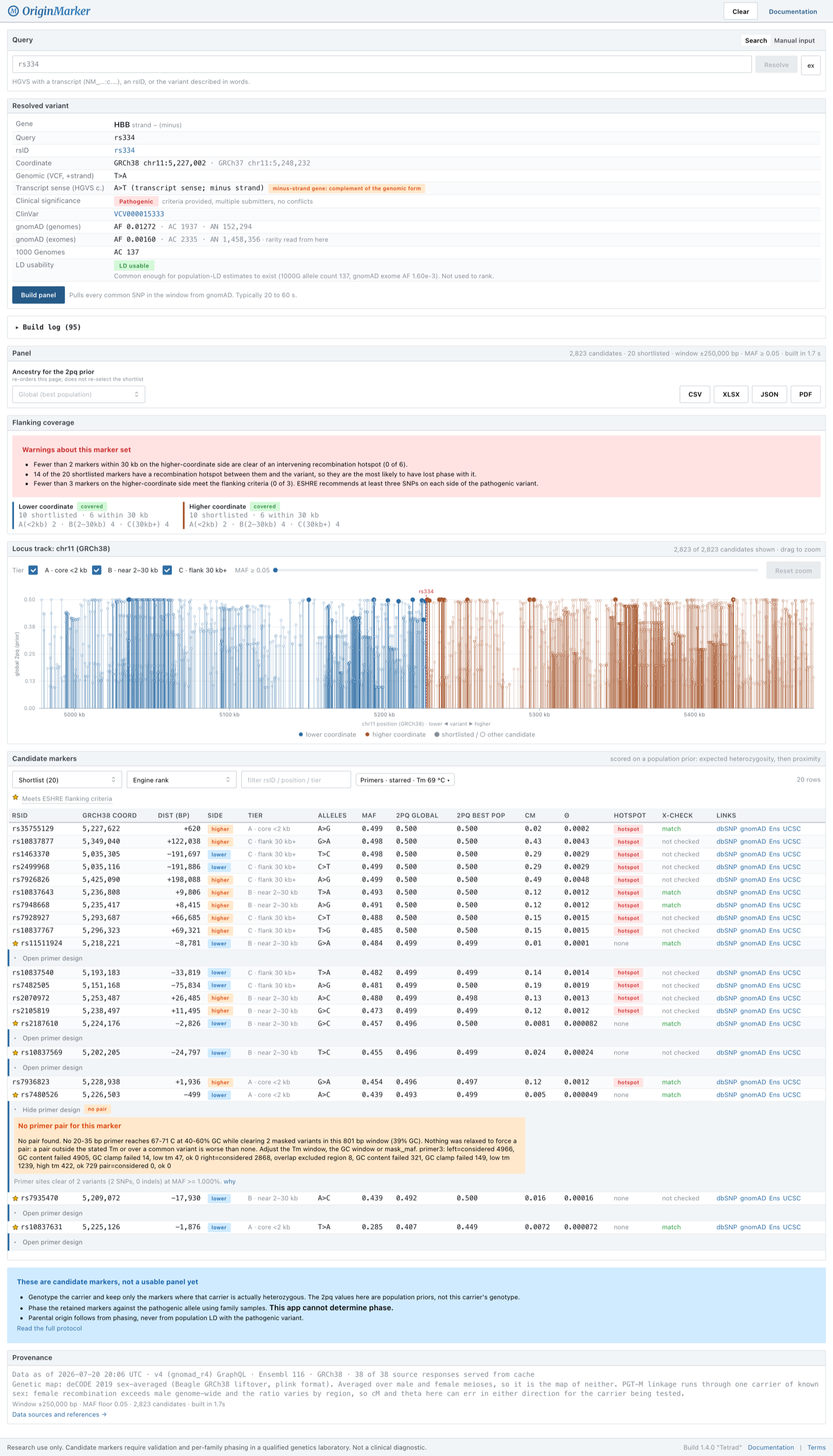
i put a tool up at ezrakruger.cc/originmarker. you give it a gene and a pathogenic variant, an rsid or an hgvs expression or just a description in plain words, and it hands back a ranked, downloadable menu of candidate marker snps flanking the variant. it is the same thread as the earlier post on confirming a variant coordinate, one step further along: once you know exactly where the variant is, this is what you build around it.
the picture, if this is new. a carrier parent passes on either the healthy copy of a gene or the broken one. after an embryo is tested you often can't read the answer at the variant itself, so you read the neighbours instead: harmless snps sitting right beside the variant that ride along on the same chromosome. genotype enough of them and you can tell which parental chromosome the embryo got, without ever needing a clean read at the variant. that's pgt-m linkage, and picking those neighbour snps well is the whole game. that's all this does: it proposes the neighbours.
it pulls everything live, clinvar and ensembl and gnomad, ranks the candidates by how informative they're likely to be and how close they sit, checks a genetic map for recombination hotspots between each marker and the variant, and covers both sides. it'll design pcr primers for the good ones and, if you want, check them against the whole genome. exports to csv, xlsx, json and pdf. it costs me basically nothing to run: the identifiers never touch a model, only the plain-english descriptions do.
the thing i'm actually proud of is that it under-claims. it proposes candidates and it will tell you, repeatedly, that it cannot phase them and cannot call an embryo's origin on its own; that's the lab's job with the actual family. i had a separate instance do a hard scientific audit of the methodology, the stats and the genetics, and it came back with no errors in the math that's implemented. what it did find i fixed in the release i just cut: it now refuses mitochondrial variants outright (linkage is meaningless there), reads gnomad's exome frequencies instead of dropping them, and spells out the cases it can't detect, de novo, uniparental disomy, mosaicism.
it's open source (github), research use only, and not a clinical anything. candidate markers still need validating and phasing in a real genetics lab. but if that's the kind of thing you do, or you just want to see how a panel gets built, it's up and it's free.
last updated 07/20/26, e. kruger